How to Choose an
Old Mine Cut
Natural Diamond
What the grading report won't tell you -- and what to look for instead.
If you're shopping for an old mine cut natural diamond, you'll probably begin where most people do: shape, carat weight, color, clarity, and the grading report. That's a smart place to start. But after spending decades buying diamonds, I've learned something that completely changes how I approach old mine cuts. I don't start with the grading report. I start with the diamond.
Before I Read the Report, I Look at the Diamond
People are often surprised when I tell them that. When I open a parcel of old mine cuts, I don't reach for the certificate first. I unfold the paper and simply look.
Is the diamond bright and crisp? Does it have a soft, warm glow? Does it have personality? Does it make me stop?
Every now and then, one immediately catches my eye. Not because it's the biggest, the whitest, or the highest graded -- but because it's beautiful. There's something about it that's almost impossible to explain until you've seen it yourself. It doesn't simply reflect light. It comes alive.
Only after I've experienced the diamond do I study the grading report.
Not because the report isn't important -- it absolutely is.
But with old mine cuts, the report helps me understand the diamond.
It doesn't tell me whether I'll fall in love with it.
Why Old Mine Cuts Read Differently
This is one of the things I love most about old mine cuts. They weren't cut to fit today's formulas. They were cut by hand, centuries ago, one natural diamond crystal at a time.
Every crystal was different. The cutter wasn't trying to force each one into a mathematical ideal. Instead, he studied the rough in front of him and tried to reveal the greatest beauty hidden inside it. Sometimes that meant leaving a little more depth. Sometimes it meant preserving weight. Sometimes it meant proportions that wouldn't earn top marks by modern standards.
Yet those very decisions often gave the diamond its personality.
"Two old mine cuts with remarkably similar grading reports can look completely different in person. One simply has a facet pattern that speaks to you in a way the other doesn't.
The Facet Pattern Tells the Story
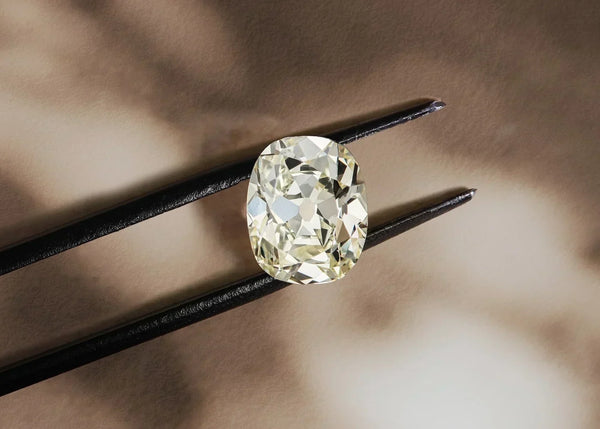
When I'm looking at an old mine cut, one of the very first things I notice is the facet pattern. I'm not looking for laser-perfect symmetry. I'm looking for harmony.
Do the facets work together? Does the pattern naturally draw my eye into the stone? Does it create those broad, confident flashes of light that make old mine cuts so captivating?
It's difficult to explain until you've seen enough of them, but every now and then you unfold a little paper, look down, and everything just feels right. The facet pattern is balanced, the light moves naturally through the diamond, and the stone has a personality all its own.
That's because these diamonds weren't cut to satisfy a computer. They were shaped by the hands and eyes of a craftsman working with one unique natural diamond crystal, making countless decisions to reveal the greatest beauty hidden inside it.
Every crystal asked something different of the cutter.
Every finished diamond became its own interpretation.
Its own work of art.
Desert Diamonds
Around our store, we've started calling many of these warmer old mine cuts "desert diamonds." The name isn't about a grading scale -- it's about a feeling. Their colors remind us of the desert at sunrise or sunset, where layers of cream, sand, gold, and amber come together in a way that's incredibly calming and beautiful. Paired with the broad, hand-cut facets of an old mine cut, those colors create a richness that's difficult to describe until you see one in person.
Warmth Isn't Something to Fear
One of the biggest surprises for people discovering old mine cuts is color. Many shoppers begin by looking for the whitest diamond possible. With antique diamonds, that's not always where the magic is.
One of the interesting things history has given us is that many wonderfully original old mine cuts are found in these softer color ranges. Over the last century, many higher-color antique diamonds were recut into modern brilliant shapes as styles changed and cutting technology evolved. While beautiful high-color old mine cuts certainly still exist, collectors today often encounter more untouched originals with a touch of warmth.
These diamonds don't apologize for their color.
They celebrate it.
Every old mine cut has its own personality. Some are bright and crisp. Others are warm and soulful. Neither is better -- they're simply different expressions of beauty. The right one isn't determined by a letter on a grading report. It's the one that makes you stop and smile.
Characteristics That Define Them
These diamonds were fashioned during an era when evenings were illuminated by candlelight. Their larger, broader facets were perfectly suited to that warm, flickering light -- producing broad flashes that roll across the stone rather than thousands of tiny pinpoints. Collectors also treasure a set of characteristics unique to this cut.
Broad Facets & Candlelight Flash
Instead of the tight, precise faceting of a modern round brilliant, old mine cuts produce slower, broader flashes. A softer, more soulful kind of light that rewards you for simply looking.
The Open Culet
Where a modern diamond tapers to an invisible point, old mine cuts often feature an open, polished culet -- a flat facet at the bottom of the stone that is a signature of how diamonds were finished by hand.
The Kozibe Effect
The open culet reflects through the crown facets to create beautiful, mesmerizing patterns visible deep inside the stone. Collectors find this one of the most captivating visual characteristics of the cut.
Hand-Cut Proportions
No two are identical. The slightly irregular outlines and proportions you sometimes see aren't flaws -- they are the direct record of a craftsman's hands and judgment working one stone at a time.
We're not searching for the highest grades. We're searching for the diamonds that make us pause.
When we're selecting old mine cuts for our collection, we set down the certificate and pick up the stone. Nature spent billions of years creating the crystal. A master cutter, working by hand, revealed the beauty hidden inside it. More than a century of history gave it character. Now it's waiting for the next chapter.
Every once in a while, I open a little paper parcel. Before I read a single word on the grading report, I already know. Not because it's perfect. Because it's beautiful.
Nature created the crystal.
A master cutter revealed the beauty hidden inside it.
Time gave it history. You become the next steward.
Find the one that makes
you stop.
Browse our old mine cut collection or speak with one of our diamond specialists.
Every stone is hand-selected at our Lighthouse Point showroom.
2428 N Federal Hwy, Lighthouse Point, FL 33064
·
(954) 941-8788
·
jrdunn.com