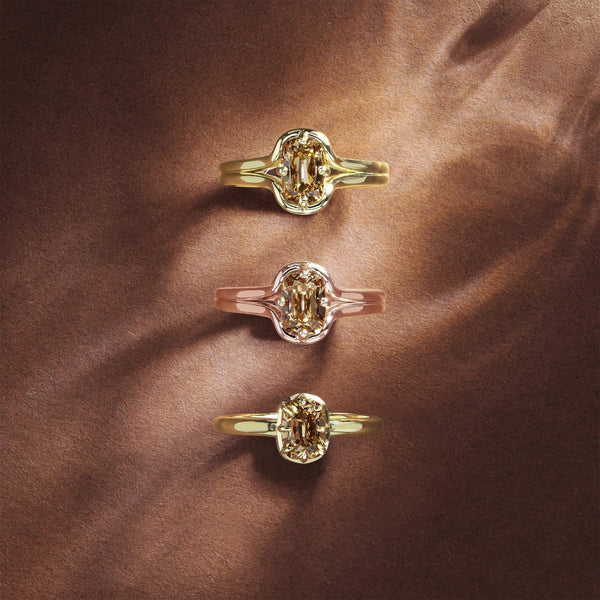
The Desert Diamond
Color Dictionary
Buttery, candlelight, honey, whisky — what does it all mean? Here's the guide we wish existed when customers first started asking.
Taylor Swift's ring broke something loose. Searches for "old mine cut," "candlelight diamond," and "warm engagement ring" surged overnight. Brides who had been memorizing D–Z color charts suddenly had a different question: what is that soft, glowing warmth in my grandmother's ring that no modern brilliant seems to have?
It has a name now. De Beers launched its Desert Diamonds campaign in late 2025, its biggest category push in over a decade, to put language around the full warm-toned spectrum. For anyone who has ever stopped at a stone that glows like honey rather than fires like a strobe, the timing is good.
The problem is the vocabulary. GIA grading was built around colorless diamonds. Closer to D, the better, full stop. That framework leaves almost no useful language for the warm end of the spectrum, which is exactly where the stones people are actually asking about live. So the words get invented on the fly. Buttery. Candlelight. Whisky. Cognac. Mocha. Ecru. They are evocative and genuinely descriptive, but they mean different things to different jewelers, different Instagram accounts, and different brides.
We built this guide to fix that. J.R. Dunn has been sourcing and selling warm-toned diamonds for decades, long before they had a campaign behind them. What follows is the most complete, honest decoder we know how to write.
"No two desert vistas are the same. No two desert diamonds are, either. That is the whole point and the whole joy."
Use this before you start shopping, before your appointment, or before any conversation with a jeweler about what you are actually looking for. The right vocabulary will get you the right stone.
The Full Palette
From the barely-there warmth of a sunlit white to the deep richness of mocha, this is the desert diamond color range mapped to the language you will actually encounter.

Every Term, Decoded
Listed lightest to deepest. Each entry shows the De Beers marketing name alongside the GIA grading equivalent, the consumer slang you will see online, and what to actually look for at the counter.
What Is a Candlelight Diamond, Exactly?
A candlelight diamond is not a color, it is a cut. Old mine brilliant cuts, old European cuts, and rose cuts were all designed before electric light, proportioned to maximize warmth and glow in candlelight rather than the cool brightness of a halogen or LED fixture. The difference is immediate in person. Where a modern brilliant cut produces sharp white flashes, an old mine cut shifts and glows rather than fires.
Most antique cut diamonds were not graded for colorless perfection. They were cut from whatever rough was available, and warm-toned stones were prized, not penalized. Candlelight cuts and desert diamond colors naturally travel together because each amplifies the other. Taylor Swift's ring from Kindred Lubeck is described by De Beers as having a warm, candlelight diamond tone, an antique cut in a naturally warm color grade. That combination is what the search term candlelight diamond now means to most shoppers.
Terms That Overlap
The same stone can carry multiple names depending on who is describing it. Here is the cheat sheet.
| Consumer Term | What It Actually Means | GIA Equivalent | Overlaps With |
|---|---|---|---|
| Buttery | A soft, even warm-white to pale yellow tone with no gray or green secondary hue. Implies a smooth, creamy quality. | J–M (faint to light) | Candlelight white, sunlit white, champagne |
| Candlelight | Technically refers to antique cut diamonds (old mine, old European) but colloquially used for any warm-toned stone with a glowing, soft fire. | Any grade; cut-dependent | Sunlit white, champagne, buttery, warm white |
| Champagne | A light golden-yellow diamond, the most commonly used consumer term. Widely applied across a broad range. | N–Z (Cape series) or Fancy Light Yellow-Brown | Straw, pale gold, buttery yellow, soft lemon |
| Honey | A golden yellow with moderate warmth, deeper than champagne but lighter than whisky. The De Beers official name for Fancy Light Brown. | Fancy Light Brown (FLB) | Ochre (lighter end), caramel, golden toast |
| Cognac | Deep warm brown, the Argyle Mine's own term. Widely adopted for any medium-to-dark brown fancy diamond. | Fancy Brown to Fancy Dark Brown (Argyle C5–C7) | Whisky, amber, chocolate, cinnamon |
| Whisky / Whiskey | Rich warm brown with notable saturation, between honey and cognac. An official De Beers Desert Diamond color name. | Fancy Brown / Fancy Dark Brown | Amber, cognac (lighter end), bourbon |
| Ochre | Earthy golden-brown, the De Beers name for Fancy Light Brown, their Desertcore anchor color. | Fancy Light Brown (FLB) | Honey (depending on use), amber, terra cotta |
| Mocha / Chocolate | Deep, rich brown approaching espresso. Chocolate Diamond is a Le Vian trademark; mocha is generic. De Beers uses sunset mocha in its bridal palette. | Fancy Deep Brown / Fancy Dark Brown | Cognac (darker end), espresso, truffle |
| Blush / Dawn | Brown diamonds with a secondary pink or rose tone. Increasingly rare since Argyle Mine closure. De Beers calls these sunset blush and dawn. | Fancy Light Pink-Brown / Fancy Brown-Pink | Desert rose, nude, peach, sunset blush |
The Answers Search Engines Miss
A desert diamond is any natural diamond in the warm-toned color spectrum, from sunlit white and cream through champagne, honey, ochre, and whisky to deep cognac and mocha. The name comes from the desert landscapes these earth-toned hues evoke. De Beers launched its Desert Diamonds campaign in October 2025, its largest category marketing push in over a decade, positioning the warm-toned spectrum as a deliberate choice rather than a compromise on colorless.
Champagne diamonds are a subset of desert diamonds, not the whole category. Desert diamonds is the umbrella term covering the entire warm-toned spectrum, from sunlit white through champagne, honey, and ochre to whisky, cognac, mocha, and blush. Champagne describes the lighter golden-yellow range specifically, typically GIA grades N through S or Fancy Light Yellow-Brown.
Both are De Beers' marketing names for diamonds in the GIA Fancy Light Brown category. In practice, honey implies a slightly more golden, yellow-leaning tone, while ochre implies a more earthy, brown-leaning tone. Both sit in the lighter end of the fancy brown range and the terms are used somewhat interchangeably. When shopping, ask the jeweler to show you the GIA certificate and describe the secondary tone, yellow vs. brown, to find the shade you actually want.
Candlelight diamond refers primarily to the cut. Old mine, old European, and rose cut diamonds were proportioned before electric light to maximize their glow in candlelight, and they produce a softer, warmer fire than modern brilliant cuts. The connection to desert diamonds is that most antique cut diamonds were not graded for colorless perfection, so warm-toned stones are the norm rather than the exception. When people search candlelight diamond they usually want both the antique cut and the warm color, though you can have one without the other.
Historically yes. Near-colorless stones with warm undertones traded at a discount to colorless diamonds because the traditional grading system treated color as a defect. Lighter desert diamonds, sunlit white and champagne in particular, have often offered meaningful value relative to equivalent colorless stones at the same carat weight. As the Desert Diamond campaign gains traction and cultural demand increases, that discount may narrow, particularly for honey and ochre. Deep cognac and mocha diamonds in larger carat weights are becoming genuinely scarce as legacy inventory depletes, and prices reflect it.
Yellow gold is the classic choice, amplifying the stone's warmth and reading as intentional rather than accidental. Rose gold adds a romantic blush undertone and works especially well with lighter champagne or blush-toned stones. White gold and platinum provide the most neutral backdrop, letting the stone's color contrast clearly. With very deep cognac or mocha stones, avoid white gold; the contrast tends to feel disconnected rather than dramatic.
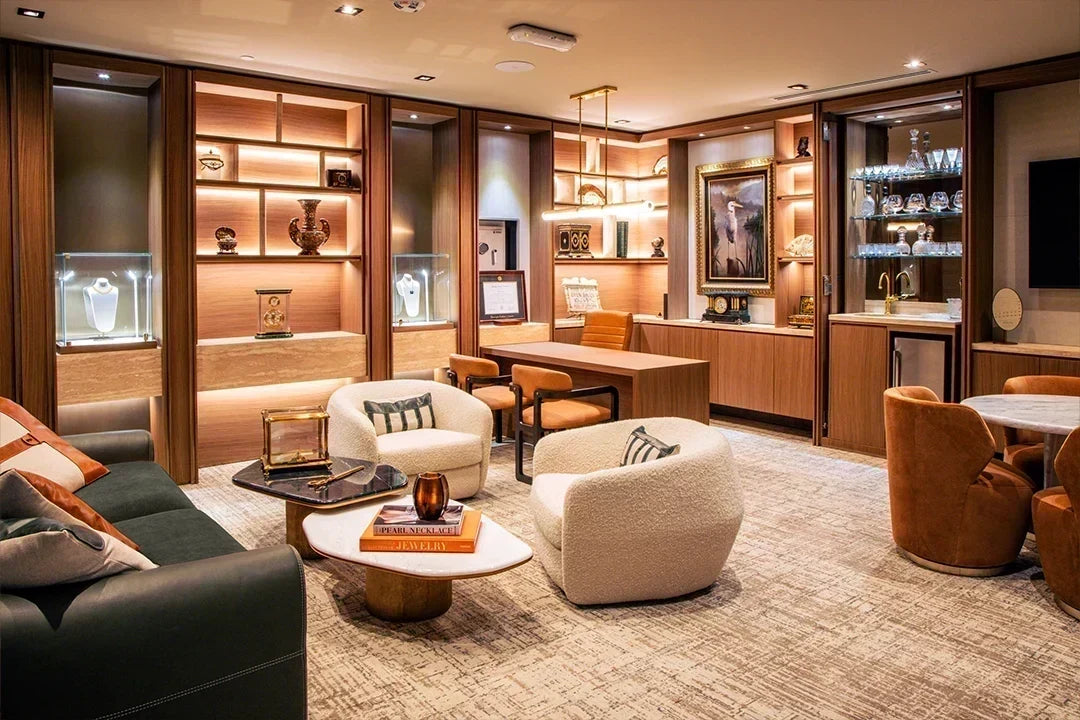
J.R. Dunn Jewelers in Lighthouse Point has been sourcing and selling warm-toned and antique-cut diamonds for decades. Our Graduate Gemologist team can walk you through the full desert diamond spectrum in person, not just GIA grades but what your eyes are actually telling you when a stone makes you stop. We welcome appointments and walk-ins at our showroom at 4210 N. Federal Highway, Lighthouse Point, FL.
The Right Stone Is Waiting.
We Know Exactly Where to Find It.
J.R. Dunn Jewelers has been sourcing fine diamonds for over 57 years. Our Graduate Gemologist team will help you move from a Pinterest mood board to a stone in your hand that makes you feel something.